
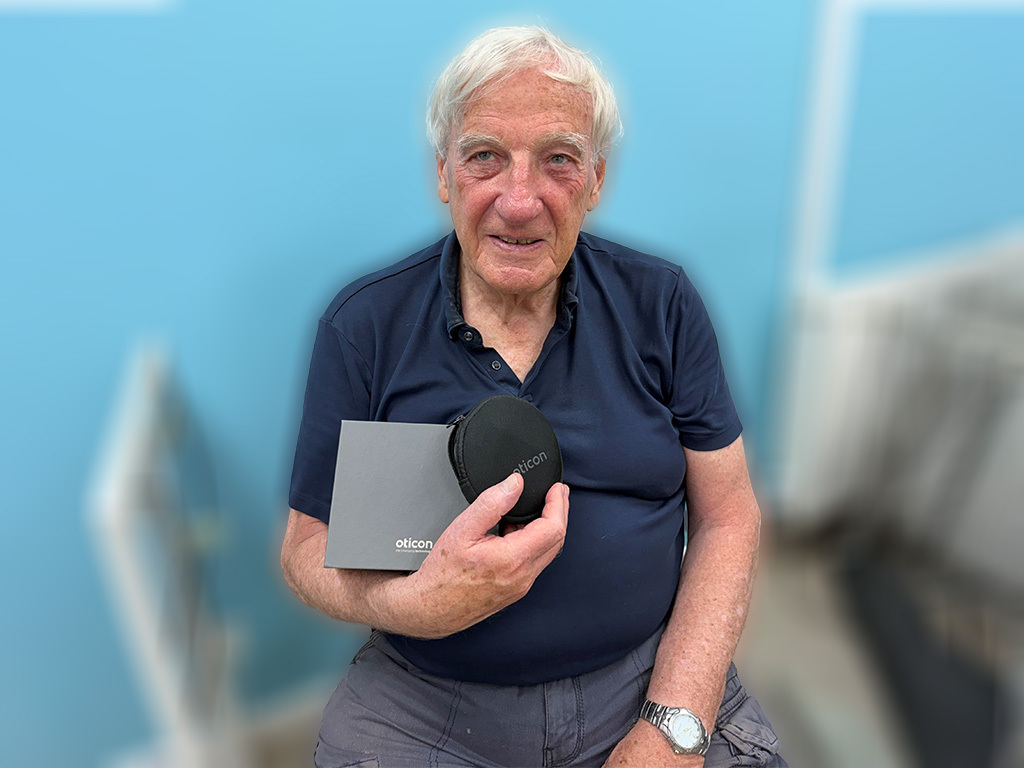
Hearing loss is something which often builds slowly over the years rather than something that appears suddenly. It starts during service, shaped by aircraft noise, firing range, loud engines, long hours in demanding environments and the everyday sounds of military life. Our veteran Mr Michael Norris shares his experience closely tied to his long career in the Royal Air Force.
After his service, Mr Norris began to live with a lasting effect of noise exposure, including difficulty hearing conversations, understanding speech in background noise and keeping up with family life in the way he wanted to. With support from the UK Veterans Hearing Foundation, funding from the Veterans’ Foundation, and a fitting conducted by Mr Richard Bunce at Hear at Home Cornwall, Mr Norris was fitted with a pair of Oticon hearing aids to help support his day-to-day hearing needs.
A Long RAF Career Surrounded by Noise
Mr Norris served in the RAF for over three decades and as a navigator, his service involved thousands of hours in aircraft, including around 2,000 hours in Shackletons and 4,000 hours in Nimrods. The working environment he had was not quiet and during flights, Mr Norris was regularly exposed to high-frequency engine noise, aircraft movement, and the constant pressure of communication in loud conditions. In the Nimrods, he would sit between the engines, surrounded by the kind of sound that many people would find difficult to tolerate for a short period, let alone for repeated long flights.
His flight often lasted up to 12 hours, two or three times a week and alongside this Mr Norris was also regularly firing ranges, using 303s and pistols at a time when hearing protection was not provided in the way it would be expected today. Mr Norris service also placed him in a wider aviation environment, surrounded by revving engines, aircraft cruising, taking off and landing. During a period in Norway, he was also exposed to noise from dynamite being used to extend office space.
After flying in Shackletons, Mr Norris became aware that his hearing was affected. He noticed that he was shouting, his hearing felt reduced and his ears would ring. Although the headsets used in Nimrods were better, the environment still required voice to be loud, as people had to speak over the sound of the aircraft. These years of exposure has left a lasting impact on him.
Understanding Mr Norris’ Hearing Loss
Mr Norris’s audiogram showed a bilateral mild-to-moderate sensorineural hearing loss. In simple terms, this means hearing loss in both ears, linked to damage within the inner ear or hearing nerve pathways.
This type of hearing loss often affects the ability to hear higher-frequency sounds clearly. These sounds play an important role in speech understanding, especially when trying to follow conversation in places where there is background noise. This kind of hearing loss makes it harder to listen to in situations such as restaurants, family gatherings, social events, car journeys, or group conversations. When several sounds compete at once, speech clarity becomes difficult to pick out.
It can also make distance, phone calls, and conversations without visual cues much harder. Even when watching telly or radio volume can become difficult at home, as the level needed for speech clarity may feel too loud for others. This is why hearing loss is not only about volume, but the greater challenge is also understanding speech clearly.
How Hearing Loss Affected His Everyday Life
The hearing loss for Mr Norris began to affect everyday moments with his family, friends, and wider social life. He struggled in social situations, especially where background noise was present, conversations became harder to follow and often needed more effort and concentration. At his home, his wife and family often needed to repeat parts of conversations, which became frustrating for everyone. The telly volume also became a challenge, as Mr Norris needed it louder than others found comfortable.
Over time, these small daily challenges can affect confidence, independence, and connection. When hearing becomes harder, many people begin to avoid noisy places, group conversations, or social settings, which can lead to isolation and a reduced quality of life.
Mr Norris had previously been seen by NHS Audiology outpatients and was fitted with the NHS hearing aids in December 2019. However, he felt they did not give him the speech clarity he needed, especially in the situation he found most difficult. While NHS hearing care supports several people, however, a few veterans need further help due to the complexity of their hearing loss and the demands of everyday listening. Mr Norris needed hearing support that better matched his needs and helped him follow speech more clearly.


Supporting Veterans Beyond Hearing Aids
UK Veterans Hearing Foundation supports veterans living with hearing loss linked to their military service. Through UKVHF, Mr Norris was able to access further hearing support. His hearing aids were funded by the Veterans Foundation, whose support helps make specialist hearing care possible for veterans who need it. Mr Norris was fitted with a pair of Oticon hearing aids by Mr Richard Bunce at Hear at Home Cornwall.
The aim was to give him clearer access to speech, better day-to-day listening support, and more confidence in the situations he found difficult. Mr Norris, this support is about more than hearing aids; it is about taking part in conversations again with his wife and family, feeling more comfortable in social settings, and enjoying everyday moments with greater ease.
The military hearing loss can follow veterans long after service ends. Its impact can be felt at home, with family, among friends and in daily routines. This is why hearing support for veterans need to be personal, practical can build around individual. Mr Norris gave many years of service in demanding noise environments.
